
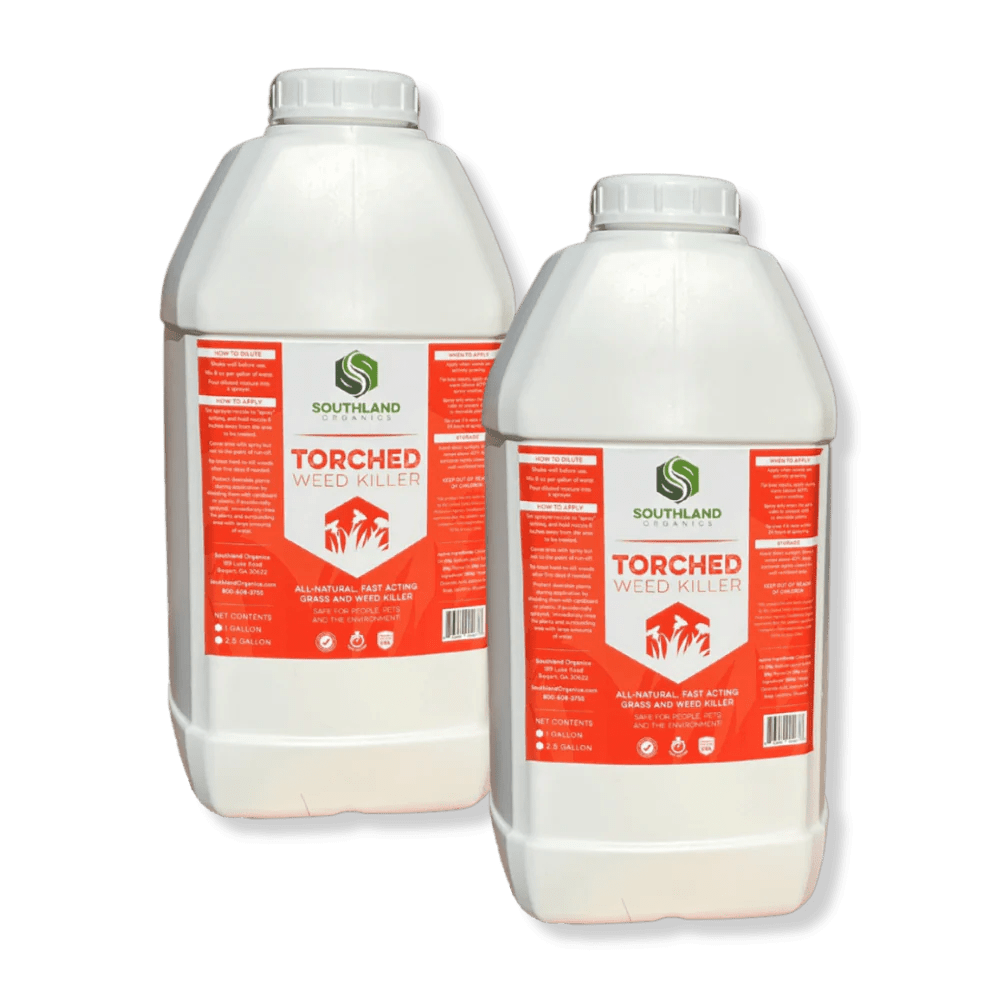
People who are deciding on Torched usually ask the same thing: is this just vinegar in a nicer jug?
No. They do the same kind of job. They are not the same product.
Torched vs 30% vinegar
Both are contact killers. They burn the leaf they hit. They do not travel to the root the way a systemic chemical does. Young annual weeds often die in one pass. Deep-rooted perennials need more than one.
That is the comparison. Not a kill-rate contest. We do not have a head-to-head trial, and we will not invent one.
What is different:
- What it is. Torched is clove oil, cornmint oil, and soap. Horticultural vinegar is acetic acid — often 20–30%. Grocery vinegar is about 5% and is too weak for this job.
- How you use it. Torched is a concentrate. Mix 8–10 oz per gallon (10–12 for hardy or mature weeds), shake, spray. Vinegar at horticultural strength is harsh to handle. You wear protection for a reason.
- How it smells. Reviewers who have used both say Torched smells better. That is their words, not a lab result.
Do not buy Torched if what you wanted was a jug of acetic acid at a lower price. Buy it if you want a mixed, plant-oil contact spray that you can use around a coop, a driveway, or a bed without leaving a soil residue.
What customers who already chose it say
These are customer reviews, not a trial.
“I have two toddlers and a dog, so Roundup was never an option for me. Torched works just as fast on the weeds in my driveway cracks and flower beds, and I don’t worry about my kids playing outside an hour later.” — Lisa Nguyen, homeowner, Nashville
“I am a bee keeper as well as trying to practice regenerative ag. I have cattle, sheep and free range chickens. Fence line maintenance with electric fencing is a nightmare without some help.” — Chris R., beekeeper and regenerative farmer
“I was very happy to find an alternative to the carcinogenic and pollinator-killing Roundup. I’ve used Southland Torched at my Florida property and it works.” — Verified buyer, Florida
The five-star reviews and the one-star reviews often describe the same thing: the top browns, then green comes back on a tough plant. The five-star people planned on a second pass.
“It does take 1 week for a full kill and does not immediately brown the weed.”
“Some tough grasses did need more than 1 application. Will buy again.”
“Requires 2–3 applications several days apart to kill off the roots on plants with a taproot.”
That is how a contact killer works. The handbook walks through what you will see after you spray.
Is it organic certified?
No. Torched is not USDA Organic.
The label says all-natural. That is not a certification.
It is classified by the EPA as a minimum-risk pesticide (FIFRA 25b exempt) — clove and mint oil on the minimum-risk list. If you run a certified organic farm, ask your certifier. We cannot answer that for them.
What it will and will not do
Torched burns the foliage it touches. It does not attack the root system. It does not leave a residue that stops the next seed. New weeds in living soil a couple of weeks later are new seeds, not the old plant “waking up” — unless you stopped after one pass on a perennial, in which case the root is spending reserves. Hit it again at 5–7 days.
It is non-selective. Flowers, food plants, and grass brown if you coat them. Shield what you want to keep. If you spray something by mistake, rinse it.
Kids, pets, and poultry can return when it is dry. We do not have a trial on horses with metabolic issues. Same rule: once dry.
Named weeds we will stand behind: dandelion, thistle, puncturevine, and established gravel-driveway weeds. We will not add names we have not earned. Bindweed has been reported as not working.
Dogs and cats: weed killer and pet safety. Poultry: chicken-safe weed killer.
How to use it
Mix, shake, sun, second pass. The full walk-through is the Torched handbook.
Buy Torched. Questions: 800-608-3755.
Written by

Founder & CEO
20+ years in organic agriculture • Humate & soil biology specialist
With years of experience in humate deposits and soil biology, Mike brings practical knowledge from the field to every conversation. He founded Southland Organics to create sustainable solutions that work with nature, not against it.
View full profileReviewed by
Founder & CEO
20+ years in organic agriculture • Humate & soil biology specialist
With years of experience in humate deposits and soil biology, Mike brings practical knowledge from the field to every conversation. He founded Southland Organics to create sustainable solutions that work with nature, not against it.
View full profile